
In short
- First compare products with a clearly described recipe and content.
- Ask which complete report belongs to the delivered batch.
- Calculate price per gram only on the same, verifiable content basis.
- Include shipping and treat reviews and effect claims separately.
- Postpone your choice if essential product information is missing.
Start with a checklist for two products
A useful comparison starts with the same questions for each offer. Place two products side by side in a note and fill in the details before expressing a preference. This means that any missing data is immediately noticeable.
For each product, note the form, ingredients, net contents, quantity of shilajit, batch identification, available reports and price including shipping. Write where you found each piece of information. A label photo, product specification and certificate of analysis can complement each other, but are not interchangeable sources.
For a missing field, use the word unknown. Do not make an estimate based on a comparable packaging or a different variant. If you don't yet know the difference between material and end product, first read what shilajit is. You don't have to know all the technical terms to ask a salesperson for specific information.
Step 1: choose which product form you are comparing
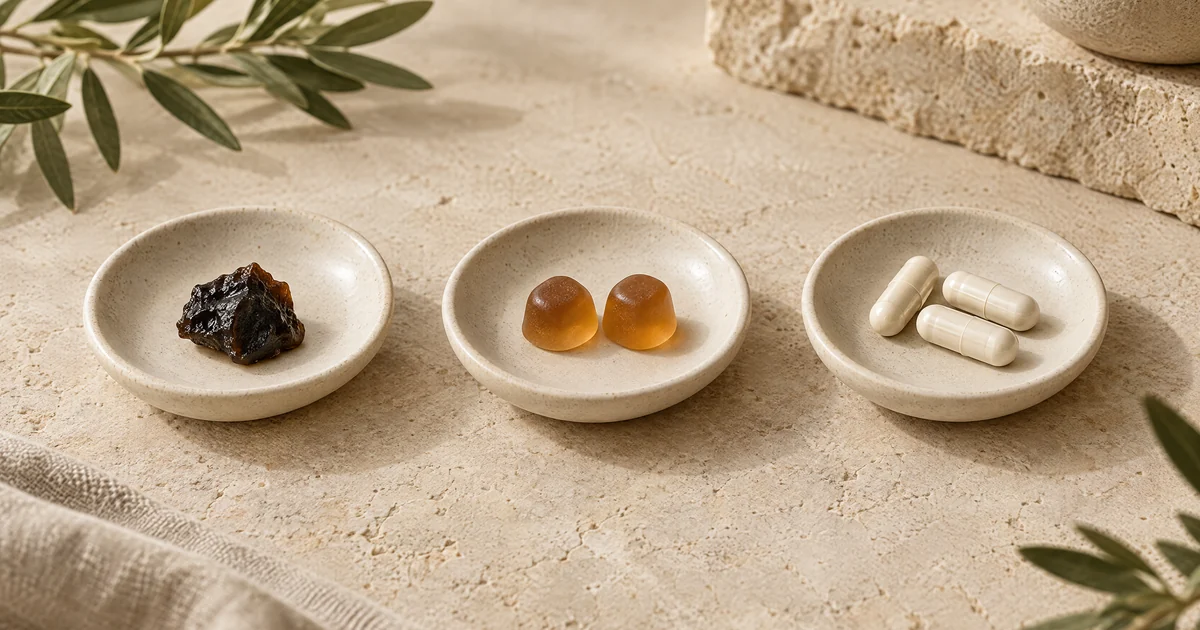
Resin means resin. Gummies and capsules are other product forms in which shilajit can be incorporated. The shape is a starting point for your comparison, not proof that a product works better.
Preferably start with two products whose contents are described in the same way. For example, with two pots of resin you look at the net content and complete recipe. For two gummy products, you also need the number of pieces and the indicated amount of shilajit per piece or specified portion.
If you want to compare different forms, explicitly note where the content differs. A gram of a complete gummy does not have to have the same composition as a gram of resin. A jar with many capsules may have a different content per capsule than a smaller package. The comparison of resin, gummies and capsules helps you determine what data is needed.
Step 2: Check the label and recipe
Read the entire product information, not just the product name or the front of the package. The NVWA explains why food information should be fair and clear. The description must match the end product that is offered.
In any case, check these parts:
- Which ingredients are listed and does the list belong to this variant?
- What is the net content and on what unit are contents based?
- Where are usage information, warnings, and retention information located?
- Who is the responsible provider and how can you reach them?
- Is the same content in the text, in the photo and in the specification?
The NVWA Information on Dietary Supplements and Sports Nutrition covers supplement information and promotion, among other things. A general web text does not provide you with product-specific usage instructions. Request the final label if it is not legible or fully published.
With gummies, the content deserves extra attention: does the stated quantity apply to one gummy or to several gummies together? The guide to shilajit gummies shows how to recognize such different units. Do not transfer content from one variant to another.
Step 3: Connect the report to the delivered batch
Ask for the full certificate of analysis of the batch being delivered. The statement lab tested is not an overview of the parameters examined. Even a crop with one result does not show what is on the rest of the document.
First check the identification: product name, sample description, batch number and date. Then find which parameters were examined, which units were used and whether the measurement method was mentioned. Compare the document information with the packaging or batch information provided by the seller.
Also ask what material was sent to the laboratory. A report on a raw material and a report on the end product answer different questions. If the link is unclear, ask in writing what conclusions the provider draws from this report for the product you receive.
Use the reading guide for certificates of analysis to recognize the fields. For measurement results regarding contaminants, also read the explanation of heavy metals. If the report is missing, note that it is missing. A logo or verbal reassurance does not complete the documentation.
Step 4: calculate price per comparable content
You calculate the price per gram by dividing the product price by the net content in grams. Only use this calculation when it is clear what the content means for both products. Different recipes do not become equivalent because you apply the same formula.
A completely fictitious example: pot A contains 50 grams and costs €40. Pot B also contains 50 grams and costs €45. The product price per gram is then €0.80 for A and €0.90 for B. These amounts have been chosen to explain the calculation; they are not current market prices, not retail prices and not a quality assessment.
Then suppose that delivery for A costs €6 and for B it is included. The total for one jar is €46 versus €45. Converted to these two fictitious packages, this is €0.92 versus €0.90 per gram. By recording shipping separately, you can see why a lower product price does not always result in a lower final amount.
Do not apply this sum blindly to total weight of gummies versus resin weight. Also, do not calculate a price per day if definitive usage information is missing. A self-selected portion would suggest advice that this guide does not provide.
Step 5: Rate promises and reviews separately
A review, a measurement report and a health survey answer various questions. A customer can describe how he experiences packaging. A report can show results from a sample. Neither of these is therefore automatically proof of a general health effect.
According to the NVWA, conditions apply to nutrition and health claims and medical claims on foodstuffs are prohibited. Therefore, be critical of promises to prevent, treat or cure diseases. For other effect claims, ask what substantiation is used and whether it relates to the recipe offered.
Read reviews mainly for the question they really answer. A comment about packaging or customer service is different from a statement about a physical effect. The guide to research and evidence will help you maintain this distinction. Don't let a high rating replace a missing label or report.
Step 6: make missing information concrete
Ask a seller for documents and answers that you can keep. A short, specific question provides more guidance than the general question of whether a product is good.
You can use these questions:
- Can you please send the full label and ingredients list of this variant?
- Which batch is delivered and which complete report accompanies it?
- Is the sample examined the raw material or the end product offered?
- Where are the final quantities, usage information and warnings?
- What do I pay including shipping and where can I find return information?
Place the response next to your checklist. If a question about batch number has been answered with only a story about origin, the batch number field is still open. Only complete a price comparison when it is clear what you are comparing. The quality page shows the documentation status for this website; contact details are on the service page.
Frequently asked questions
How do I recognize the best shilajit?
A ranking or product name alone does not provide a verifiable comparison. Start with ingredients, clear content and batch documentation. Then compare products on the same data. This guide does not name a brand as the best, because no documented comparison of concrete parties has been carried out.
Does cheap shilajit automatically mean lower quality?
Without product information, price does not reflect quality. First check what the packaging contains and what documentation it comes with. Then take the total price with you. A higher price is also no substitute for missing information.
What if the seller cannot send a batch report?
Then you cannot judge the results of that party based on that report. Make a note of what documentation is missing and request that a full report be made available. Postpone your choice when you need that information for your assessment.
Can I directly compare two 50 gram jars?
You can calculate their price per gram, but for a substantive comparison you also need the recipe and product data. The same net weight does not guarantee the same composition. Also check whether it really concerns the net contents.
How this buying guide was put together
This buying guide has been compiled with desk research in the primary sources mentioned, consulted on October 12, 2026. The checklist organizes questions you can ask about product information. No products were purchased or tested for this item and no laboratory testing was performed. The calculation example is only an explanation of the formula.
The confirmed range on this website consists of Resin 50 grams, Pure 50 grams, Gummies and Complex. Recipes, levels, quantities for Gummies and Complex and usage instructions have not yet been definitively confirmed. Prices are demo information, sales are disabled and batch documentation is not yet available.
A good comparison ends with a completed checklist in which it is clear what is known and what is still missing. Start with the label and then request the appropriate report. The reading guide for certificates of analysis is the next step once you have received a document.
Sources & background
Sources are linked to the relevant explanations in this article. They do not support any approval or effect claim for Select. Our own selection criteria are separate from this.
NVWA: honest and clear information on the label ↗NVWA: nutritional supplements and sports nutrition ↗NVWA: nutritional claims and health claims ↗