
In short
- A number of gummies do not tell you how much shilajit the package contains without the content.
- Check whether a stated content applies per gummy, per portion or per jar.
- Vegan, sugar-free and taste are separate properties of a specific recipe.
- Ask if an analysis report describes the raw material or the finished gummies.
| Given | What does it tell? | What does it not tell? |
|---|---|---|
| Number of gummies | How many pieces the package contains | How much shilajit each gummy contains |
| Net content | The total weight of the contents | The weight of shilajit alone |
| Content per gummy | The stated quantity of a described ingredient | A personally appropriate amount |
| Portion on the label | To which the stated quantity or instruction relates | A general advice for all gummies |
| Ingredients list | The stated composition of this product | The composition of another recipe |
| Analysis report | Measurement data about the described sample | A general health effect or automatically all product characteristics |
The ingredients list describes the specific product
The composition of shilajit gummies varies per recipe. In addition to the intended ingredient, substances may be present that determine structure, taste or shelf life. You cannot deduce which ones they are from a product photo or from the word gummies.
Therefore, read the full ingredients list. Find out how shilajit is described and what other ingredients are listed. Ask for clarification when the ingredient description on the product page differs from the label. A general description such as “natural formula” does not replace the concrete recipe.
The NVWA on clear food information explains that food information must be honest and clear. Make this a practical check: can you write down what you get based on the available data, without coming up with ingredients yourself? For the differences with other forms you can also use the comparison of resin, gummies and capsules.
Gummy weight and shilajit content are different numbers
The total weight of a gummy is not the same as the amount of shilajit in that gummy. A gram listing may describe the entire chewable unit, while a milligram listing may describe a single ingredient. Also the net contents of the jar include the entire contents, not automatically just shilajit.
Then check what the level refers to. A large number on the front may apply per gummy, per recommended serving or for the entire package. Please look for the corresponding explanation before comparing it with another product. One clear number without that context remains incomplete.
Include the name of the ingredient literally in your comparison. Does it say shilajit, extract or a mixture? Write that description next to the quantity. Don't assume that different descriptions mean the same thing. In the shilajit buying guide you will find a way to record missing or discrepant data.
A calculation example helps to understand the units
You can convert a per gummy quote to the amount in a specified serving, as long as the original data is clear. That's a check of the label, not advice on how much to use.
Suppose a fictional jar contains 60 gummies. The fictitious label lists 75 mg of a specified shilajit ingredient per gummy and calls a serving size of two gummies. You can then distinguish three different quantities:
- Per gummy: 75 mg of the described ingredient.
- Per mentioned portion: 2 × 75 mg = 150 mg of that ingredient.
- Per jar: 60 × 75 mg = 4,500 mg, or 4.5 grams of that ingredient.
The net content of the jar may be higher due to the other recipes. You must also read that total weight separately.
These numbers have been chosen solely to show the calculation. They do not describe any product on this website, no measured content and no recommended amount. Even a correct calculation does not prove equivalence with another raw material, another extract or another product form.
If a label only lists the number of gummies, a necessary input for this calculation is missing. Then ask for the content per unit and its meaning. Do not use the total weight of the gummy as a substitute.
Vegan, sugar-free and taste require separate checks
A gummy is not automatically vegan, sugar-free or fruity. The name also does not indicate which gelling agent was used. Check each property against the relevant recipe and the information provided by the provider.
Make your question specific. For a plant-based diet preference, you want to know which ingredients and excipients have been used. With a sugar claim, you want to know exactly which claim is on the label and what product information accompanies it. With flavor you want to know the named flavor, not just the color of the image.
Also ask these questions when packaging shows a quality mark-like image. Ask what the image refers to and what information is available to check the property. A dark gummy does not confirm high shilajit content; a fruit image does not confirm a composition. Keep the product form and individual properties separate in your notes.
The full label extends beyond the front
When choosing a product, you also need instructions for use, warnings and the responsible provider. A short advertisement or influencer post usually does not offer the same space as full product information. Therefore, check the seller's label before starting a price comparison.
The NVWA information about dietary supplements and sports nutrition lists ingredients, contents, usage advice, warnings and responsible company data as relevant label information. Ask for a readable image or a written version if data is missing.
Keep for yourself which information belongs to which packaging. An older label photo does not necessarily have to describe a current recipe. Check product name and version if a provider sells different versions. This prevents you from using information from one pot for another.
An analysis report must match the sample described
First ask if the report describes a raw material or the finished gummies. That difference determines how you should read the measurement data. A raw material report can provide relevant information, but does not automatically describe the complete end product with all other ingredients.
Check sample description, batch code, date and measured parts. Ask how the provider makes the link between the packaging sold and the sample examined. Also note what the document does not examine. A report with a few metrics does not answer an unlimited list of questions about a product.
The reading guide for certificates of analysis helps to distinguish between identification and results. Use that check next to the label. The label tells what the provider states; the report describes certain measurements on a specific sample. Neither by itself is evidence of a general health effect.
The gummy shape does not determine its legal status
A chewable form does not automatically make a product a candy or an authorized dietary supplement. The status requires assessment of the specific product, the ingredients and the way in which it is offered.
The European Commission consultation document on mumijo makes a distinction: according to that document, mumijo is not new as or in food supplements, but it is when used in other foodstuffs. That's not a blanket endorsement of every shilajit gummy or new formulation.
For a consumer, the useful question is therefore how the provider has rated the specific product. Do not derive an answer from the product form. Traditional use, attractive packaging and a gummy recipe each answer a different question than the status of the food offered.
Frequently asked questions about shilajit gummies
Are gummies the same as shilajit resin?
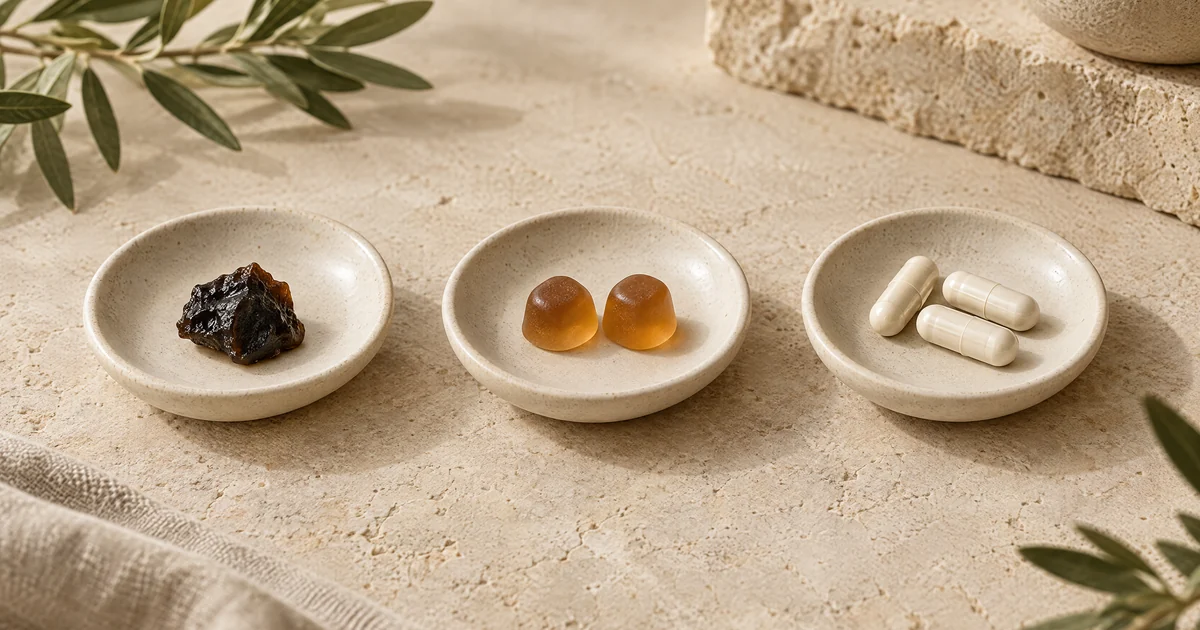
No. Gummies are a chewable product form that may contain shilajit; resin is another form. The weight of a complete gummy cannot be directly equated to resin weight. Compare the described ingredients and contents, as explained in the form comparison.
How Many Shilajit Gummies Should You Use?
This reading guide does not indicate usage quantities. For this you must look at the instructions of the concrete, final product. Do not copy a quantity from another gummy, resin or capsule based solely on a similar product name.
Is a larger pot automatically cheaper?
A larger number of gummies does not provide a complete comparison without content and final price. First compare the quantity per gummy, ingredient description and portion on the label. Only then calculate the cost of the same clearly described quantity.
Does a health promise prove that gummies are better?
No. A commercial promise does not replace appropriate substantiation. Moreover, nutritional supplements may not be promoted with medical claims, as the NVWA about claims explains. The explanation of research and evidence helps to assess product information and effect claims separately.
What is still open for your own gummies?
Gummies belong to the confirmed range of Shilajit Select, alongside Resin 50 grams, Pure 50 grams and Complex. The final gummy recipe, amount of shilajit, quantity per jar, flavor, usage instructions and batch documentation have not yet been released. Vegan or sugar-free properties have not been confirmed. The shop is a demonstration with test prices and no sales have been released.
Use this reading guide to prepare for a concrete product comparison. Collect a complete label, record the content in the correct unit and ask which report accompanies the packaging. Then continue with the pre-purchase checklist. This way your decision remains based on data that you can actually read.
Sources & background
Sources are linked to the relevant explanations in this article. They do not support any approval or effect claim for Select. Our own selection criteria are separate from this.
NVWA: honest and clear information on the label ↗NVWA: nutritional supplements and sports nutrition ↗NVWA: nutritional claims and health claims ↗European Commission: consultation status mumijo ↗