
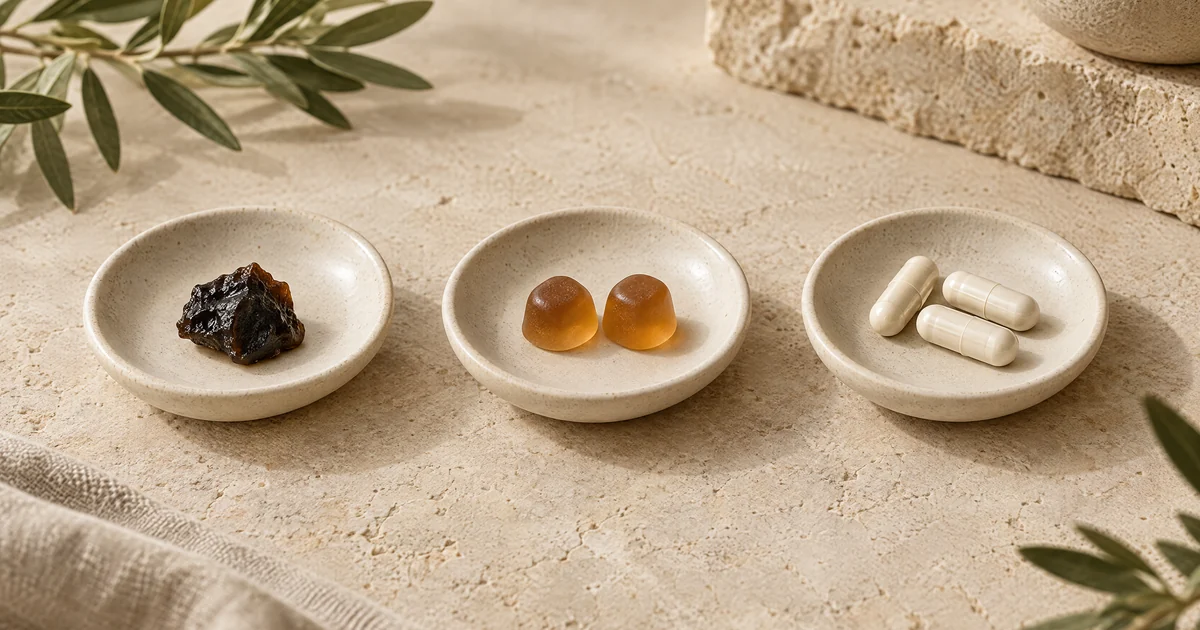
In short
- Resin and resin mean the same product form, but not automatically the same composition.
- Net content, amount of shilajit and number of gummies or capsules are different data.
- A useful comparison requires the same units and a clearly defined ingredient.
- Check which product and which batch an analysis report actually describes.
| Checkpoint | Resin / resin | Gummies | Capsules |
|---|---|---|---|
| Product form | Resin mold | Chewable form | Encapsulated content |
| Practical preference | Work with resin according to the label | Chewing, taking taste into account | Take capsules according to the label |
| Composition | Check full ingredients list | Check Shilajit and other recipes | Check contents and capsule shell |
| Quantity | Net content and stated amount of shilajit | Shilajit per gummy and per stated serving | Shilajit per capsule and per stated serving |
| Packaging | Weight says nothing about purity | Number says nothing about quality | Number says nothing about quality |
| Documentation | Product and batch linking | Distinguish raw material or finished gummy | Distinguish raw material or finished capsule |
| Which the form does not prove | Quality, safety or efficacy | Quality, safety or efficacy | Quality, safety or efficacy |
Resin and resin mean the same product shape
Resin is the English word for resin. So a package with “shilajit resin” and a package with “shilajit resin” can describe the same kind of product shape. The word itself does not tell where the raw material comes from, how the product is processed or what composition a specific pot has.
Therefore, compare the information behind the name. Is only shilajit on the ingredients list, or have other ingredients been added? Is the net content clear? Do the product name and specification match the document provided by the seller? Two dark resins may appear similar in a photo while their records differ.
A name like “pure”, “premium” or “original” is also not a measurement result. Ask what specific characteristic is meant by it. A visible, verifiable answer is more useful than an extra adjective. The buying guide for shilajit contains the information you can collect in advance.
Gummies and capsules require a full recipe
With gummies and capsules you are comparing a composite product, not just the name shilajit. In addition to the intended ingredient, for example, a gummy may contain substances that determine taste and structure. With a capsule, both the contents and the shell are relevant. Which substances are present must be apparent from the actual ingredients list.
Note the distinction between product form and property. “Gummy” does not automatically mean vegan or sugar-free. “Capsule” does not automatically mean that the entire contents are shilajit. A fruit image does not confirm a particular flavoring, and a green packaging does not confirm a vegetable capsule shell.
The NVWA on clear food information emphasizes that labels must provide consumers with honest information. Therefore, use the label as a starting point and ask the supplier for an explanation if the webshop states something different. Our reading guide for shilajit gummies discusses content, recipe and packaging separately.
Compare quantities with the same meaning
Net content, the quantity of an ingredient and the number of pieces are different data. Fifty grams of resin, sixty gummies and sixty capsules cannot be directly compared as a measure of the amount of shilajit. With gummies and capsules, the number only indicates how many pieces are in the package.
For each product, note the amount of shilajit per unit, the amount per portion stated on the label and the description of that ingredient. Check whether a number applies per gummy, per capsule, per portion or for the entire package. Also read the unit: a milligram is one thousandth of a gram.
A fictitious calculation example makes the distinction clear. If a label states 100 mg of a specified ingredient per capsule, two capsules together contain 200 mg of that ingredient. That is a calculation, not usage advice. It also does not say that 200 mg of different ingredients or extracts are substantively equivalent.
Make missing data visible. Write “not stated” when the amount of shilajit is missing and leave the equation blank at that point. A self-entered number makes the comparison clearer, but less reliable.
Ease of use remains a personal preference
You can have a preference for chewing, capsules or working with resin, without making any statements about health effects. Practical questions include whether you like clear preparation instructions, whether taste plays a role and whether the packaging suits the place where you want to store the product.
Read the usage and storage instructions for the specific product. Do not assume that advice for resin also applies to gummies or capsules. The recommended serving size from one provider is also not a general standard for all products with the same name.
The NVWA Dietary Supplement Information helps to understand this product category. The practical next step is simple: make sure the full label is available before you make a choice. A product photo of just the front usually does not answer all the questions you have about that choice.
Documentation must match the specific product
An analysis report can only be used properly if it is clear what was investigated. Check the sample description, product identification, batch code and date. A report on a raw material does not automatically answer the same questions as a report on finished gummies or capsules.
Also ask what the report examines. A document with one measured property is not a judgment about the entire product. Look separately at which sample was examined, the results and what those results mean. A laboratory logo alone on the product page does not provide this information.
The NCCIH Fact Sheet on Ayurveda, updated in 2019, describes, among other things, concerns about metals in some Ayurvedic preparations. This is information about Ayurveda as a whole; it does not prove that every shilajit product is contaminated. Appropriate documentation remains necessary for a specific product. The reading guide for analysis certificates helps to check the link between sample and packaging.
Only calculate the price if the comparison is correct
A price comparison only has meaning if it is clear what you are paying for. The price per jar can be helpful for your budget, but does not tell you the number of comparable servings if content or instructions are missing. The price per gram of total gummy is also not the price per gram of shilajit.
First compare the price, net content and stated quantity. Also include which ingredient is meant. Write down any shipping costs separately. Do not calculate a price per specified portion until that portion appears on the final label. This makes it clear which packaging your calculation relates to.
A lower price and larger packaging do not justify better quality. Conversely, a higher price does not indicate more careful processing. To make a choice you need both the costs and the product file.
Frequently asked questions about the three forms
Is resin better than capsules or gummies?
Product form alone does not substantiate an overall winner. Compare concrete products based on composition, quantity, label and documentation. A statement about operation requires different substantiation than a statement about practical ease of use. The explanation of research and evidence describes this distinction.
Does a capsule always contain only shilajit?
No, that does not follow from the capsule form. Read the entire ingredient list and see what portion of the listed content is actually shilajit. The capsule shell is also part of the information you check for your personal dietary preference.
Can you use the same amount of resin and gummies?
Do not transfer quantities from one form to another. Gummy weight and resin weight do not automatically describe the same composition. Only follow the instructions of the specific product; this comparison does not provide dosage advice.
Can a provider promise that a form will handle complaints?
Food supplements may not be promoted with medical claims. That ban does not depend on resin, gummy or capsule. The NVWA on nutrition claims and health claims explains the rules. Promising a treatment is not a product feature with which you can compare these forms.
What is still open in your own range?
For Shilajit Select, Resin 50 grams, Pure 50 grams, Gummies and Complex have been confirmed as an assortment. The final recipes, levels, numbers of gummies or capsules, usage instructions and batch documentation have not yet been released. Properties such as vegan or sugar-free have not been confirmed either. The shop is a demonstration with test prices and no sales have been released.
In the meantime, use the shape equation to write down your own review questions. Collect the same label and file data for two concrete products and mark what is missing. The next step is the pre-purchase checklist, so that a practical preference is combined with information you can review.
Sources & background
Sources are linked to the relevant explanations in this article. They do not support any approval or effect claim for Select. Our own selection criteria are separate from this.
NVWA: nutritional supplements ↗NVWA: honest and clear information on the label ↗NVWA: nutritional claims and health claims ↗NCCIH: Ayurvedic Medicine: In Depth ↗